LCD module test

LCD module test or how to connect the beast to PC printer port.

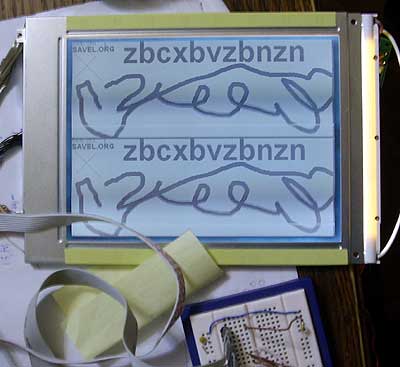
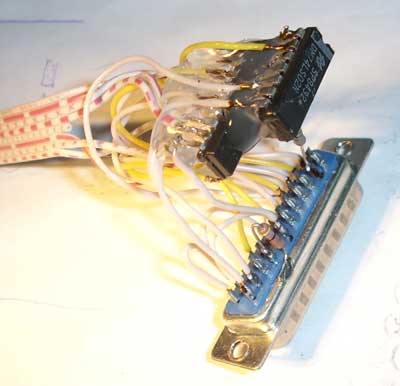
I received few requests how to test the LCD module using easy to obtain software. Maybe people are to lazy to search internet… So, here is simplified instructions how to connect standard LCD module to PC computer port (LPT) and how to configure WinAmp plugin.

The circuit diagram is very simple. Attention! Some old or nonstandard, “winter”, modules require additional power supply to be connected to Vee pin (contrast). But most of the modules are working from regular voltage, and you connect Vee pin to ground or using some trimmer connect it between Vcc (+5V) and ground (GND). All standard modules after power-up show one dar line to demonstrate that they are working.

The circuit itself is very simple. Take note to trimmer on Vee.

Continue reading

Posted in Anything | 2 Comments

White LED driver

After I smashed about 5 mobile phones and collected some white LEDs, I decided to build some some LED searchlight. There are two ways to solve this problem: first, Chinese version, just connect some white LED’s to battery and use some ballast resistor. And watch you spotlight fading while the battery is loosing it’s power. Ante the second, hi-tech, way. To build special LED driver.

almost all recent white LEDs are in fact blue LEDs with special coating to emit missing wavelengths and the result is white color. To use LED and full efficiency, you must supply constant working current to LED. It is possible to connect LED in daisy chain way using only one current ballast, but the voltage must be quite high (~3V per LED) or connect them in parallel. But in parallel mode you must use separate ballast for each LED.

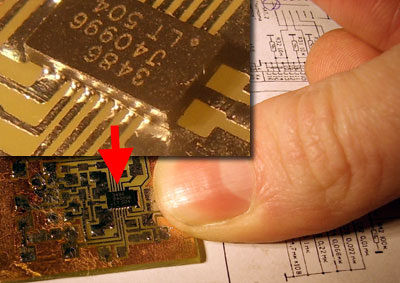
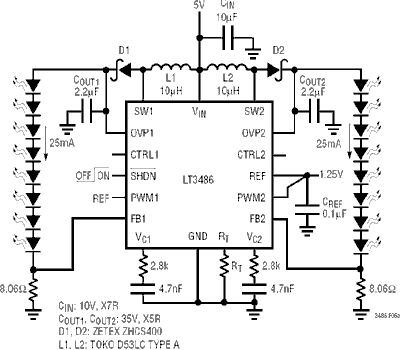
Chip manufacturers make special chips- LED drivers. This chip lets you to connect LEDs in daisy chain and is working from single cell. I received sample from Linear Technologies. It is LT3486, dual channel white LED driver from single Li-ion cell.

It is generic step-up converter with feedback from current shunt resistor and over-voltage protection. In sample circuit there are 2×8 white LEDs connected to chip. But other example is with 2×16!

I thing the limit is only max power on the chip, max voltage on the output (35V) and max current (~25mA typical) per channel. And the number of diodes are not very significant value.

The only bad thing is that chip is “new style”, lead-less and very small…

White LED driver

The circuit is very simple. All component are easy to get. As I love using second hand components, I had some difficulties collecting very small 10μH inductors. Thanks to Samsung digital cameras, I removed inductor from camera’s PCBs. Other component was fast schottky diode- recommended one was ZHCS400 (40V, 400mA), but I placed IR1F4 (10BQ040), 40V, 1A. I don’t know if it is fast enough.

White LED driver circuit diagram

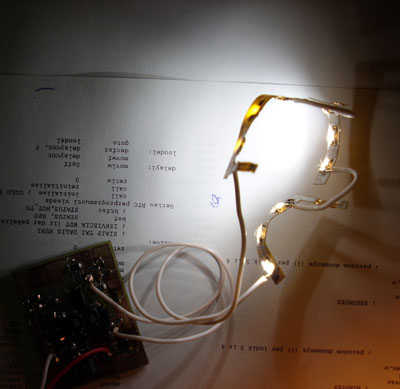
This is first run. Only one channel is working- 9 White LEDs from mobile phone back-light. Power supply is one LiIon cell (~4V). The voltage across LEDs are 29V, empty circuit voltage- 36V. White LEDs are getting quite hot- I made some mistake in calculations and LEDs are overloaded.

White LED driver

Continue reading

Posted in Anything | Leave a comment

Sweep generator

You maybe noticed time gap in my weblog. I am constructing more complex device at this time and don’t have spare time for usual weblog entries. So I posted only few old re posts and some small note from “vandalising” theme.

My “great” project is seep generator with some additional features.

Final product will output: sweep signal in square, triangle and sin form. Also sweep generator can be used as wide band generator. Also, by adjusting few knobs the output can be transformed to sawtooth- left or right side.

The main device is still under construction, but some results can be posted here:

Sweep generator

This is frequency characteristics of standard 455kHz ceramic filter. There is lack of detector and frequency marks, but something is showing. I can not tell that the output is right as I don’t have other equipment to test or compare the results.

Other features: the generator has the frequency modulation (FM) and pulse width modulation (PWM) inputs.

Continue reading

Posted in Anything | Leave a comment

Wireless mouse

I am using wireless mouse for several years. Recently I collected some same model spare mice for my experiments. It is low frequency (~27MHz, CB band!) mouse with docking station to charge two AAA batteries. All other specifications are typical. The only annoying thing this this mouse are side buttons programmed to act as “back” and “forward” in internet explorer. Also there is another quite annoying feature- very short time for idle time. Just leave the mouse for minute without moving and it change status to standby. You need to press any button to revive the device.

Wireless mouse

The radio range is quite short, but who is using mouse in big distances. In my experiments, the max distances was about 3 meters.

Time to open the mouse…
Continue reading

Posted in Vandalising | Leave a comment

Fast PCB desoldering

Transferred from old and some-why Google banned pages.

Chip, PCI/AGP/ISA/MCA/CPU and etc. slot desoldering from PCB board

After lots of experiments of desoldering multipin parts from PCB using fancy irons, gas torches, hot air guns and other stuff I “invented” this technology. Using this technology all parts do not get mechanical stress and PCB board is not damaged. This method is ideal for multilevel PCB. I didn’t find any damage to parts caused of using this technology. The only bad side of this technology that ALL parts are desoldered. It is impossible to desolder selected parts.
This technology is free for personal use. If you want to use this technology in industry, please contact me as it is © by Levas. 🙂

Preparing: Remove all jumpers, batteries, socket-ed parts. Also remove all plastic mounting devices used to fix board in casing. Check solder side for bent pins. Prepare grill grid and few vials for collecting fat. Better use 3 ones. One in oven, two other on floor.

PCB desoldering: prepare the board
Continue reading

Posted in Anything | Leave a comment

Switch load using COM port

I was asked to switch load using computer’s COM port (RS232). At first, I was thinking, that I need to switch some lamp or heater, so I offered to use solid state relay and forget all the electronics. But later, I was explained, that I need to manage wireless access point connected to router. As the access point tends to hang-up the administrator need to reboot it. Automatically from linux router script.

I offered simple variant- use the mosfet. Here is the first version of the device in mine breadboard… somewhere in this image. 🙂

RS232 DTR as power on switch
Continue reading

Posted in Anything | 1 Comment

Car MP3 player

In local supermarket I bought small car MP3 player. It cost about $25 (79Ltl). It is USB MP3 player with FM modulator. Just plug it to cigarette igniter socket, tune car radio, put your USB flash memory stick and enjoy the music.

mp3 player FM

I didn’t hope to receive good quality sound from such cheap device, but the real situation is much worse. The sound is full of interferences. Especially when there is some pause in your music. The interference is dual- from the car itself and from USB player.

Both interferences are solved in different ways. So, first of all, we must disassemble the device. It is very easy, just unscrew the fuse holder and remove the ring.

Continue reading

Posted in Anything, Vandalising | 33 Comments

MSP 430

At last I received my MSP430 development kit. The problem is, that Texas Instruments didn’t know geography and they didn’t discovered new EU countries. So, my parcel moved to Lichtenstein instead to Lithuania. So I invested 34 devalued US dollars and received some small items:

MSP430

The print on the box says: MSP430 Ultra-Low-Power MCUs eZ430-F2013 Development Tool. There is CD and small USB device inside the box. The CD is with neutered software. The C compiler is limited to 4K!. The USB device is special development tool with small daughter board with F2013 micro-controller.

For now I didn’t made anything useful from this stuff. The software is not very user friendly. The example code is very small (on the cd) , only some blinking LED. I downloaded more examples for TI website. When I’ll find some spare time, I’ll examine it more.

USB device can be opened. So you and attach some wire to inside board or change daughter board. Windows XP detected this device as multi-port adapter and installed drivers from TI CD.

WindowsXP device manager

Posted in Anything | Leave a comment

Something wireless

Blog post for information only.

In trash pile I found something strange. It was like spot light and pizza box hybrid. Inside lamp box I found some wireless stuff- some controller, PCMCIA wireless LAN card and PSU. The pizza box was antenna.

wireless

Wireless LAN PC Card, Simple mobility NL-2511CD Plus EXT2 (High Power (23dbm) Conexant/Intersil PC Short Card-NL-2511CD)
Controller based on Axis Communications CPU without any significant prints on silk screen. Some sticker with MAC address. LAN connection and power in slot. Three LEDs: power, LAN and Wireless.

Other PCB is power supply and PCMCIA adapter.

wireless

Antenna made in Israel: MARS Antennas & RF Systems Ltd.
MA-WA24-1X PM

After some investigation I discovered that few years ago one wireless internet providers used such devices for end user points. Now these devices are almost obsolete.

Posted in Anything | 2 Comments

Spot Welder

Sometimes it is great need to weld some metal sheets together. Sometimes they are very small, like nickel plated battery connectors. There are special industrial devices for spot welding, but for DIY and hobbyist user it is very easy to build this welder at home.

All you need is few very big capacitors, thick wire and DC power supply. Sometimes you need to put some resistance in such device, and automotive headlight lamp is very good alternative. The PSU must be as powerful as possible. Output voltage must be less than maximum voltage of capacitor and safe to handle.

point welder

Circuit diagram of the spot welder is something like this:

spot welder circuit diagram - schematics

In my experiment I used 3 capacitors 100 000µF at 16V each. It is recommended to use variable output power supply to change the welding power. Too much power may make holes in your battery pack. Before welding useful device make some practice on some bad cells.

Here is my experiment with steel tape-like detail from digital photo camera. It is about 0.25mm thickness nickel plated steel. Double spots made connection quite durable. Never use single spot- it tears of very easy. For battery packs prepare special nickel plated or pure nicker foil. As simple steel or copper will corrode in time.

point welder: some nickel plated steel

Magnified welding spots:

point welder: close up to spots

Posted in Anything | 8 Comments